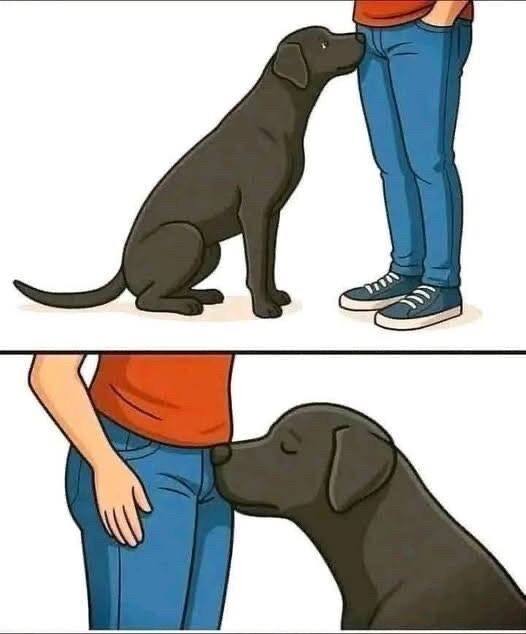
Dogs move through the world guided primarily by scent, a sense so powerful and detailed that it reshapes how they interpret reality, relationships, and emotional meaning. While humans rely on vision and language to make sense of one another, dogs rely on chemical information carried invisibly through the air. Every human body constantly releases microscopic scent signals that reflect internal processes such as stress, mood, hormonal changes, health status, and identity. The areas humans consider private happen to be rich in apocrine glands, which produce complex pheromones that convey especially concentrated information. When a dog leans in to sniff these areas, it is not acting impulsively or disrespectfully; it is engaging in what, in canine culture, is a deeply informative and socially appropriate form of greeting. In a single moment, the dog learns who you are, how you feel, whether you are familiar or new, calm or anxious, healthy or unwell. This exchange is the canine equivalent of a full conversation. To the dog, scent is not invasive; it is clarity. It provides certainty in a world where meaning is gathered through inhalation rather than words, and it allows dogs to navigate human interactions with confidence and emotional attunement.
Human embarrassment arises from cultural norms that frame bodily privacy as sacred, yet dogs do not share these social rules. They are not violating boundaries out of dominance or mischief, but rather following instincts shaped by thousands of years of social evolution. In dog-to-dog interactions, sniffing the groin area is a standard introduction, offering immediate insight into another animal’s identity and emotional state. When dogs extend this behavior to humans, they are including us in their social framework rather than excluding us from it. This is an act of recognition, not impropriety. That said, dogs are highly adaptable and capable of learning human expectations. With gentle guidance, redirection, and consistent cues, they quickly understand that humans prefer different greeting rituals. Teaching a dog to sit, stay, or focus on a hand instead of leaning forward respects both human comfort and canine curiosity. What matters most is recognizing that the instinct itself is rooted in trust and interest. A dog that sniffs you is not ignoring your dignity; it is attempting to understand you in the most honest way it knows how.
The same sensory system that leads dogs into these awkward moments is also responsible for their extraordinary emotional intelligence. Dogs detect shifts in human chemistry long before words or facial expressions reveal them. Changes in cortisol, adrenaline, and other stress-related hormones subtly alter body scent, signaling anxiety, sadness, or fear. Dogs notice these changes immediately. This is why a dog often approaches quietly when you are upset, rests its head on your leg during moments of distress, or refuses to leave your side when you are ill. To them, emotional states are not abstract concepts but measurable biological signals. Their noses read feelings the way humans read tone of voice. What feels like an embarrassing sniff is, biologically speaking, part of the same system that allows dogs to sense emotional pain and respond with empathy. They are not just smelling bodies; they are monitoring well-being.
This capacity explains why dogs excel in service roles that require extraordinary sensitivity. Medical alert dogs detect seizures before they occur, sense dangerous drops in blood sugar, and respond to panic attacks with remarkable accuracy. Emotional support dogs recognize early signs of trauma responses and intervene with grounding behaviors. None of these abilities are mystical. They are advanced applications of the same instinctual process used in everyday interactions. Dogs treat scent as a constant stream of information, and they build behavioral responses based on patterns they observe. When they notice a change, they act. When they detect distress, they stay close. Their loyalty is not blind; it is informed by continuous sensory feedback that tells them when their presence is needed most. This is why dogs often appear to “just know” when something is wrong. They are not guessing. They are reading signals humans cannot perceive.
Understanding this transforms the way we interpret canine behavior. What once seemed awkward or inappropriate becomes a reminder of how deeply dogs are attuned to us. Their noses connect them to our emotional rhythms, physical health, and sense of safety. Scent becomes a bridge between species, allowing dogs to understand humans without language. When a dog sniffs, it is grounding itself in familiarity, reaffirming connection, and updating its understanding of you. Your scent is not just information; it is reassurance. It tells the dog that you are present, that you are part of its world, that the bond still exists. This is why dogs are so deeply affected by separation and loss. Scent anchors memory. It keeps relationships alive even in absence. To a dog, knowing your scent is knowing you.
Ultimately, this behavior reveals something profound about the human–dog relationship. Dogs do not love us abstractly. They love us physically, chemically, and instinctively. They know us through the smallest details we never notice releasing into the air. When a dog sniffs you, it is not judging or embarrassing you; it is acknowledging you fully, without filters or social constructs. It is seeing you as a whole being rather than a curated image. In that moment, the dog is present, attentive, and open. This is the same presence that makes dogs such steadfast companions, such intuitive protectors, and such honest friends. To be known by a dog is to be known without pretense. Their noses tell them the truth, and they choose to stay anyway. That choice, repeated every day, is the foundation of one of the deepest bonds humans have ever formed with another species.